Making compost: heaps, trenches and what goes in
Compost is rotted organic matter, and there are three working ways to make it on a small plot: give it to an animal, bury it in a trench, or build a heap that gets hot. This page sets out what the archived composting notes recommend for each, with the measurements they give and the materials they allow.
The editors of Notes from W4 –
What may go in
The list in the composting notes archived here in 2006 is long and ordinary: grass, leaves, weeds, kitchen waste, newspaper, cardboard, straw, hay, junk mail, wood shavings and sawdust. One caution is attached to the last two. The wood must be wood, and not HDF or MDF, which the notes are told is poisonous. Tree leaves are a separate case: kept to themselves they become leaf mould, so they should not simply be folded into the general heap unless there are only a few.
The animal first
The quickest route to compost runs through an animal, and the notes call the result the best there is. There is a condition. Fresh animal manure will burn the roots off most plants. Roses are said to take it fresh, but the notes do not recommend the practice; everything on the plot gets the same rotted compost instead. Any animal manure may be used except cat and dog.
Or a trench for the winter?
The easiest method in the notes is a trench: dig one, keep throwing organic matter in, and let it rot below ground. This is a job for late autumn, winter and early spring, because at other times of year the flies would be a problem. Runner beans are the crop that rewards it, their roots running down into the filling. If beans are not wanted, cover the trench with nine inches, or 23 centimetres, of earth and start again in spring, covering each addition to keep the flies down. A little lime now and again is said to work magic. Every six to nine inches of material, add an inch of soil, which helps hold the nitrogen in, and keep everything just moist. A trench that will not be dug out wants at least nine inches of soil on top; the worms do the rest. For covering the ground between crops rather than filling it, see green manure before winter.
The heap, and the box that holds it
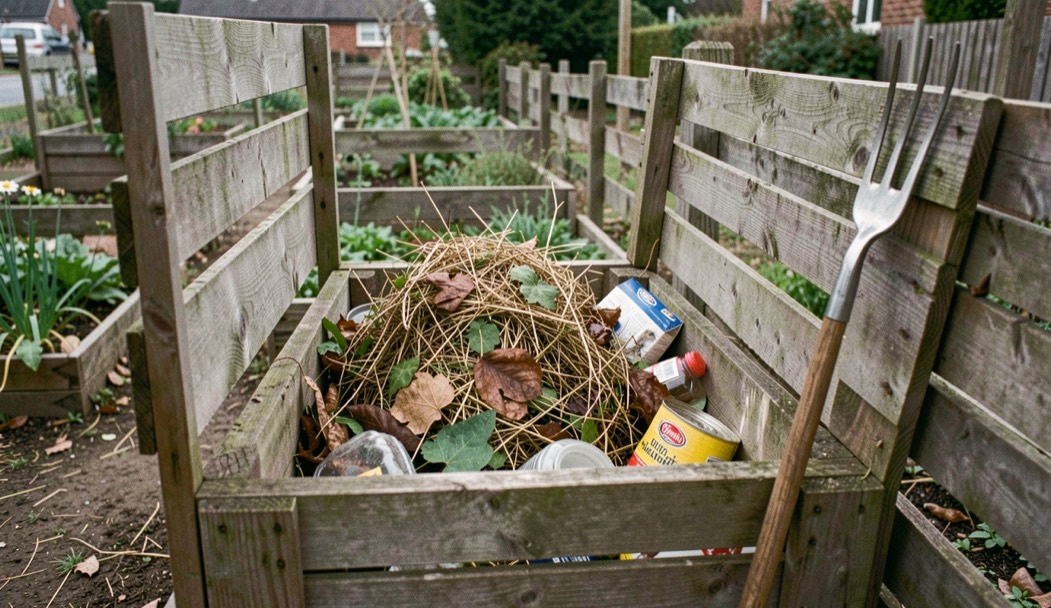
The usual way is a heap in a container of some kind. The notes list the shop versions: plastic, slatted, round, oval, narrower at the top than the bottom, and the tumbling sort turned by a handle. All of them work. One can also drive four posts into the ground, wrap chicken wire round and fill it up, and this last one suits leaves, which given time make leaf mould. Plastic bags with holes in them, moistened and filled, will also do the job, though too much water gives slime rather than the crumbly black stuff.
Why five feet matters
The method the notes favour is pallets on stout corner posts, with the inside measuring at least five feet, one and a half metres. A heap of that scale gets hot enough to kill the things a plot is not allowed to burn, since bonfires are not permitted. The list of nasties includes weed seeds, potato haulms, bad potatoes and tomatoes. Getting the heap hot means building it rapidly, not adding to it slowly over months.
Building the heap in three bins
The notes describe three bins of this size. The first collects suitable organic matter until there is a fair amount. The second is built in layers, and the order is worth copying. Coarse material goes in the bottom, then a good layer of stable manure, then material from the first bin, then fresh grass if it can be had, stale grass if not, and as many Russian comfrey leaves as can be spared. Everything must be nicely damp. Urine, if used, is diluted ten parts water to one part urine, during the build-up stage only; once the initial burn has passed, no more. An inch or two of earth caps the layers, then more manure, and the sequence repeats to the top. A small supply of vegetable waste and soft weeds is bulked out with stable manure. A few tree leaves may be mixed into it.
Cover, and let the worms finish
At the top goes a good layer of earth, or a sheet of plastic to stop the gases escaping. The cover keeps rain out, so the moisture in the heap stays under control, and it draws moisture upward, keeping the heap even. Over that, an old blanket or sacking holds warmth and darkness, and the worms like it dark. The third bin is filled the same way when enough material has gathered. What happens next, the worms, the turning and the black jelly of humus, is covered in the page on soil in winter.
The concrete gesture is this: stand the pallets this weekend, measure the inside, and if it comes to less than five feet, widen it before the first load goes in. A heap too small to heat will not kill a weed seed, and the whole point of building fast is lost.
| Method | Best season | Key measurement |
|---|---|---|
| Trench | Late autumn to early spring | Nine inches (23 cm) of soil on top |
| Chicken-wire bin | – | Suits leaves for leaf mould |
| Pallet heap | Built rapidly | At least five feet (1.5 m) inside |
The point of a heap is to feed beds that end up on a plate: eating what a small plot grows follows the same produce from bed to kitchen.