Pond and bog: planting the wet end of the plot
A pond of 60 cm at the centre and a bog kept wet by its own membrane will hold more life per square metre than any dry bed on the plot. This page sets out the two water features of a wildlife planting plan published on this address in 2004, the depth, the lining and the species lists, so the wet end can be planted from the paper rather than from guesswork.
The editors of Notes from W4 –
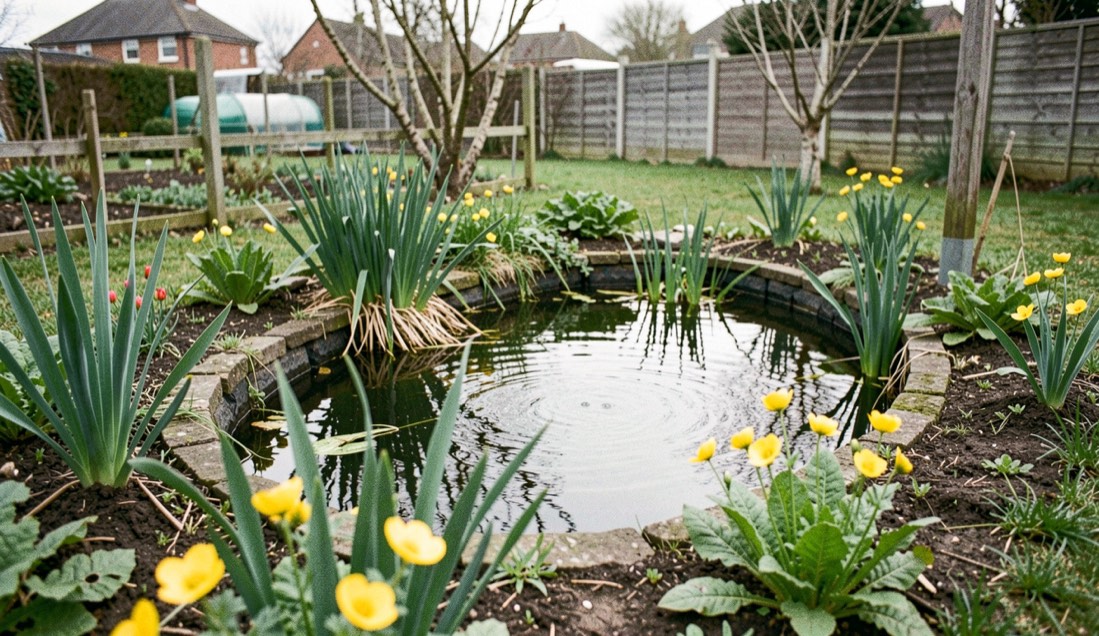
Two wet places, two membranes
The plan separates its water into a pond and a boggy area, and the separation is physical: each has its own butyl membrane. That is the first decision to copy. A bog kept wet by the pond’s overflow is at the pond’s mercy; a bog with its own liner holds moisture on its own terms and can be planted with species that want constant damp without crowding the open water. The pond is drawn 60 cm deep at the centre, with gently sloping edges. The slopes are not decoration. They are the planting shelves and the way in and out for animals, and a pond with straight sides gives neither.
How deep, and why 60 centimetres?
Sixty centimetres is the figure the plan commits to, and it is worth holding to. Deep enough at the centre that the water column does not swing wildly in temperature; shallow enough at the rim, because of the slopes, that marginal plants sit with their feet wet and their crowns above water. The plan does not give a surface area for the pond, so we do not invent one. What it does give is the planting, sorted by where in the water each species lives, and that sort is more useful than any drawing.
Plants for the open water
The submerged layer is two species: Myriophyllum spicatum (spiked water milfoil) and Potamogeton crispus (curly pondweed). Both grow below the surface, oxygenating the water and giving cover to whatever moves through it. The floating layer is four: Nymphaea lutea (yellow water lily), Nymphoides peltata (fringed water lily), Polygonum amphibium (amphibious bistort) and Potamogeton natans (broad-leaved pondweed). The two lilies shade the centre; the pondweed and the bistort spread across it. On a small pond, floating cover is the thing to ration, because it multiplies.
The boggy area, species by species
Nine plants are listed for the boggy ground, marked with a key – a for annual, b for biennial, r for rhizome or bulb, p for perennial – which is the honest way to say which will stay and which will need replacing. The perennials carry the structure: Eupatorium cannabinum (hemp agrimony), Lychnis flos-cuculi (ragged robin), Lythrum salicaria (purple loosestrife) and Veronica beccabunga (brooklime). The rhizomes and bulbs give the early season: Filipendula vulgaris (dropwort) and Petasites hybridus (butterbur). Two more sit on the list without a key mark – Caltha palustris (marsh marigold) and Filipendula ulmaria (meadowsweet) – and the page does not say which class they fall in, so neither do we.
What happens at the rim?
The edge detail is written plainly and it is a good one. Stones go around the rim to provide shelter for small wildlife, and the butyl is bent back from the rim and buried under earth. The buried flap does two jobs at once: it stops the liner showing as a black ring, which reads as a paddling pool rather than a pond, and it anchors the edge against frost movement and feet. The stones on top of that earth give the invertebrates and the amphibians somewhere to sit that is neither open water nor bare soil.
Safety, and the limits of a plan on paper
The plan carries warning signs in its notes: danger pond, no access for unsupervised children. That is a matter for the site and its rules rather than for this notebook, and rules differ between sites, so the page says so and stops. The same plan restricts every plant to native species and reserves the whole plot for organic cultivation, which is why the wet end is planted from these lists and not from a garden-centre shelf. The wider layout – the meadow beside the water, the log-slice paths, the hedgehog shelters under brambles – is covered in the planning page for a wildlife plot, and the dry meadow that borders the bog has its own species list in the meadow page.
Where the lists came from
The species and the edge detail above are taken from the archived planting lists of 2004, which sort the wet ground into bog, submerged and floating layers and mark each plant by life cycle. The page does not give quantities, spacings or a water surface area, and a pond built from it will still need those decided on the ground: how much of the surface the lilies may take before they are thinned, and how wide the planting shelf is cut. Depth, liner, slope and species it does give, and those four are enough to start digging.
web.archive.org
The pages cited here are copies held by web.archive.org, a service that stores snapshots of web addresses at given dates. The planting lists and the wildlife plot plan survive there as they were published in 2003 and 2004, after the original pages changed. The snapshots are the source of every species name and measurement on this page.
A pond is water held on purpose, which is the opposite of drains and standing water where the ground will not let it go.