Native trees and shrubs for a small wild corner
A wild corner on a small plot starts with wood, and the wood has to be chosen. This page sets out the trees and shrubs listed in the planting plan archived at this address, with the two spacings that govern everything: 3 metres between trees, 1 metre between shrubs.
The editors of Notes from W4 –
Why the choice of wood comes first
A wild corner is not a flower bed with taller plants in it. It is a structure, and the structure is the trees and shrubs. Everything else in the plan, from bulbs beneath the hedge to a meadow strip beside it, depends on the wood being in the ground and standing up on its own. The plan held in the archived tree and shrub list does two jobs at once: it names the species, and it fixes the spacings. Those two decisions, species and spacing, are the whole of this page.
Which trees, and how big do they grow?
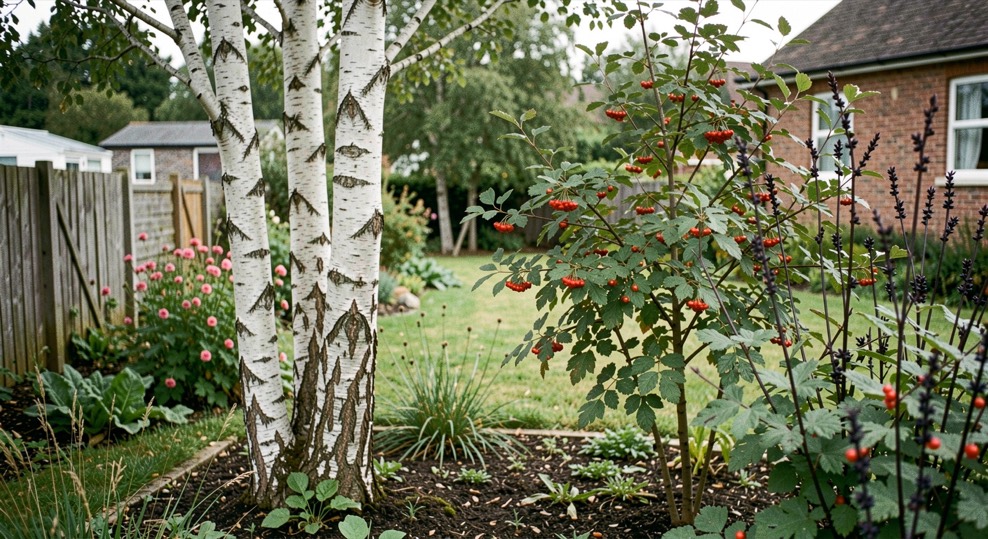
The tree list is short, which is itself information: a small plot does not need many. The named species are Betula pendula (silver birch, given as reaching 25 metres), Ilex aquifolium (holly), Populus tremula (aspen poplar), Sorbus aria (whitebeam, given as 10 metres) and Sorbus aucuparia (rowan). Alongside them sit smaller varieties: Crataegus monogyna (hawthorn), Malus sylvestris (crab apple) and Rhamnus cathartica (common buckthorn). Two heights are written down and the rest are not. A birch at 25 metres and a whitebeam at 10 metres are different propositions over a neighbour’s fence, and the plan leaves the reader to notice that difference rather than comment on it.
Three metres, watered, mulched
The care line for trees is one sentence long, and every word of it is a job. Plant 3 metres apart. Water in. Mulch. Keep watering through the first years. Three metres is the figure to hold: it means a row of five trees runs 12 metres from end to end, which is longer than most small plots are wide. That is the arithmetic that decides how many of the list a given corner can actually carry. The plan does not give a height or a season for planting, so this page does not either.
What makes a shrub rather than a tree?
The shrub list answers the question by example rather than definition. The species named are Cornus sanguinea (dogwood), Cytisus scoparius (broom), Prunus spinosa (blackthorn), Rosa arvensis (field rose), Rosa canina (dog-rose), Rosa pimpinellifolia (burnet rose), Rubus caesius (dewberry), Ruscus aculeatus (butcher’s broom) and Salix repens (creeping willow). Three roses and a willow that creeps: these are plants that stay at or near body height, and the list treats them as a single group with a single spacing of 1 metre. Watered in, mulched, and watered for the first years, exactly as the trees.
The plants that refuse to choose
Between the two lists the plan sets a third category, large shrubs or small trees, and it is more useful than it first looks. The species there are Crataegus laevigata (Midland hawthorn), Frangula alnus (alder buckthorn), Salix caprea (goat willow, with the note that a male plant is preferred and that it does not require a moist site), Salix triandra (almond willow) and Sambucus nigra (elder). To these the plan adds all the hedging plants, which also make good shrubs or small trees. That last clause matters on a small plot: the hedge species already listed elsewhere on this site can be read as a stand-alone shrub border, and the fuller species list and cutting regime are on the native hedging page.
How the spacings compare
Three spacings now exist across the plan, and they are worth setting side by side, because the difference between them is the difference between the jobs the wood does.
| Planting | Spacing | Result |
|---|---|---|
| Hedge, double row | 30cm (5 plants per metre) | A dense line, minimum height 1.6m |
| Shrubs | 1m | A thicket that fills in over a few seasons |
| Trees | 3m | Open grown, each crown kept clear of the next |
Ten hedge plants therefore cover what one shrub covers, and one tree claims the ground of nine shrubs. On 253 square metres of plot, the tree line is the decision that spends the most ground, and it is the one worth measuring twice. How to measure the ground in the first place is set out on the page on plot size.
What the plan leaves open
The archived list is a planting plan, not a growing manual. It gives species, spacings and first-year watering, and it stops there. It does not say when to plant, how to prune any of this wood once it is established, or how quickly the shrubs at 1 metre will close together. What it does record is that the whole scheme sits inside a wildlife plot to be cultivated organically, with plants restricted to native species, as the wider wildlife plot plan sets out. The trees are the slowest part of that plan and the hardest to undo, which is why the heights that are written down, 25 metres and 10 metres, deserve more attention than the ones the list leaves blank. Where the corner faces a prevailing wind rather than a sheltered fence, the same question sharpens into choosing wood that has to stand in it.
Dry ground changes what can be planted: trees for a dry summer sets out shade, watering and the species that hold on.